AI news this week shows how Grok Bot, ChatGPT and Claude are reshaping everyday work
Want articles like this for your own video to promote it on YouTube and Google? Order them through the Telegram bot @sat_sit_bot. It writes articles around your video, embeds the video and publishes them on popular niche websites (no ads). Your first 50 articles are free.
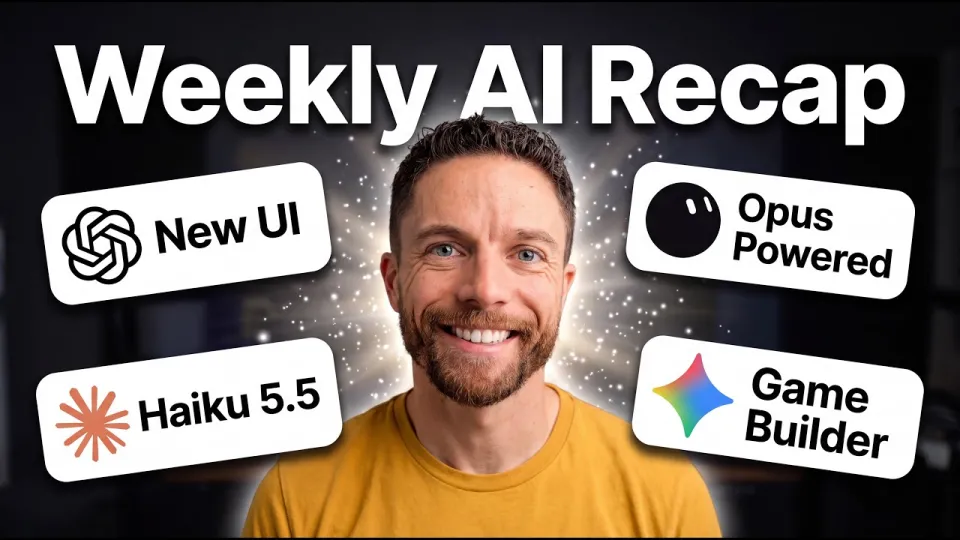
AI news this week centers on a simple shift: assistants are turning into managers of other tools. Grok Bot is being built to hand tasks to Claude, Midjourney and Suno, ChatGPT is getting an Intelligent UI, Claude Cowork is moving to the cloud, and Google is reshuffling Gemini plans; you can try the tool featured in the recap through Okou's signup page. The weekly format from Paul J Lipsky packages these releases into one organized rundown, which is why viewers keep calling it the easiest way to follow the chaos.
What the AI news cycle actually delivered this week
The through-line in this week's AI news is orchestration: the assistant stops being the product and becomes the layer that decides which product to use. Grok Bot's plan to route work to Claude, Midjourney and Suno is the clearest example, because it implies a bot that writes with one model, generates images with another and produces audio with a third, then assembles the result. ChatGPT's Intelligent UI points in the same direction from the interface side: instead of a fixed menu of modes, the surface adapts to what you are trying to do. Claude Cowork's move to the cloud removes the requirement that your own machine stays online while an agent works. Google's side of the recap covers Playground testing, Gemini plan changes and Nano Banana 2.1, the image model label that keeps appearing alongside Gemini updates.
Grok Bot as an orchestrator rather than a single model
Grok Bot's headline move is delegation, and delegation is what separates an agent from a chatbot. According to the recap, the bot is designed to reach for Claude when reasoning-heavy text work is needed, Midjourney when images matter and Suno when audio is the deliverable. That matters for practical workflows because most real projects are multi-format: a product launch needs copy, visuals and a voiceover, and stitching three separate subscriptions into one request is a genuine time saving.
The strongest evidence comes from a viewer who described handing a bot a shared folder of business videos, giving instructions for a social media clip, receiving a voice script, recording it and sending it back for assembly. The result, by that account, beat what they were paying an outside editor to produce. Treat that as an anecdote rather than a benchmark, but it illustrates the pattern: the bottleneck moves from generating assets to briefing the agent clearly.
One caution worth repeating. A viewer noted that a primary bot appeared in their account without warning, they assumed something had gone rogue and deleted it, and they could not restore it afterward. If a new agent shows up in your workspace, read what it is before removing it.
ChatGPT's Intelligent UI changes the surface, not the model
ChatGPT's Intelligent UI is a redesign of how the product presents itself, and the practical effect is fewer decisions made before you start typing. A fixed interface forces you to pick a mode, a tool or a model first; an adaptive one infers the right tool from the request and surfaces it in context. For everyday users the visible change is that ChatGPT looks noticeably different, which is exactly how the recap frames it.
The trade-off is predictability. When the interface chooses for you, you need a way to see and override that choice, especially for work where the model version matters. A sensible habit is to state the deliverable explicitly in the first sentence, name the format you want, and check which tool was used before you ship the output.
Claude Cowork goes to the cloud and what it fixes
Claude Cowork moving to the cloud solves the most common failure mode of agent tools: the laptop closing mid-task. A cloud-hosted coworker can keep working while you are in a meeting, on a commute or asleep, and the results are waiting rather than lost. It also makes shared team workflows more realistic, since the work no longer lives on one person's machine.
The trade-off is access and governance. Once an agent runs remotely, someone has to decide which files it can reach, how long outputs are retained and who reviews what it produced. Set those boundaries before you hand over a folder, not after.
Google's Gemini plan changes, Playground and Nano Banana 2.1
Google's segment of the recap combines plan restructuring with hands-on testing, and the plan details are the part most likely to affect your bill. Gemini tiers have been shifting, and one viewer pointed out that a higher storage tier now bundles a Pro-level model, which is the kind of detail that changes the math for anyone already paying for cloud storage. Check the current tier table directly rather than relying on secondhand summaries, because bundle contents move faster than documentation.
Nano Banana 2.1 is the image model name attached to this update cycle, and Playground is where the hands-on testing happened. The useful question for any image model revision is not whether samples look good but whether it holds character consistency and text rendering across several generations in a row. Test that yourself with a fixed prompt before rebuilding a workflow around it.
Questions viewers keep asking about these AI tools
The most repeated request under the recap is a beginner-friendly walkthrough of Claude Code, which tells you where the real friction sits. People are not confused about what these tools are; they are confused about the first step. A non-technical tutorial would need to cover installation, what a terminal command actually does, how to point the tool at a project folder and how to review changes before accepting them.
The second recurring theme is trust in autonomous agents. The folder-to-finished-video story and the deleted-bot story are two sides of the same coin: agents are capable enough to be useful and opaque enough to be alarming. The practical answer is to start with a narrow, reversible task, keep the source files intact and expand permissions only after you have seen the output quality.
The third theme is cost. Bundle changes, tier reshuffles and the arrival of new subscription layers mean the cheapest plan today may not be the cheapest next month. Review what you actually use monthly rather than annually.
Conclusion
The takeaway from this week's AI news is that capability is increasingly about routing, not raw model quality. Grok Bot reaching into Claude, Midjourney and Suno, ChatGPT adapting its interface to the task and Claude Cowork running in the cloud all point at assistants that manage a stack on your behalf. That makes briefing skill and permission hygiene more valuable than memorizing which model wins a given benchmark. Paul J Lipsky's weekly recap is a useful way to keep that stack in view without reading every changelog. If you want to try the tool featured in the episode, start at Okou's registration page.
Key takeaways
- Grok Bot is being positioned as an orchestrator that can call Claude, Midjourney and Suno instead of relying on a single model.
- ChatGPT's new Intelligent UI changes how tools and modes are surfaced, making the interface adapt to the task at hand.
- Claude Cowork moves to the cloud, so collaborative agent work no longer depends on a local machine staying awake.
- Google is reworking Gemini plan tiers, and Nano Banana 2.1 is the image model name circulating in the same update cycle.
- Google Playground was tested hands-on, and Claude Code for non-technical users is the most requested follow-up from viewers.
Source: Weekly AI Recap: GrokBot Just Did the Unthinkable, ChatGPT Looks Completely Different & More! · Markdown version
Questions & answers
Can Grok Bot really use Claude, Midjourney and Suno in one workflow?
That is the plan described in this week's recap: the bot acts as a coordinator that routes text work to Claude, image generation to Midjourney and audio to Suno, then assembles the output. Availability and exact behavior depend on the rollout in your account, so verify which integrations are live before building a process around it.
What changes with ChatGPT's Intelligent UI in practice?
The interface adapts to the task instead of making you pick a mode first, so ChatGPT looks and behaves noticeably differently. The model underneath is not the story here; the story is fewer setup decisions before you start. State your deliverable clearly and check which tool was used before shipping the result.
Why does moving Claude Cowork to the cloud matter?
A cloud-hosted agent keeps working when your laptop is closed, so long tasks finish without you babysitting them. It also makes shared team workflows more practical because the work no longer depends on one machine. The cost is that you need clear rules on file access, retention and review.
Is a non-technical Claude Code tutorial worth making?
Viewers repeatedly asked for exactly that, which suggests the gap is onboarding rather than concept. A useful guide would cover installation, what each command does, how to target a project folder and how to review proposed changes safely. Until then, start with a small, reversible task and keep backups.